

Google Business Profile Optimization — A practical guide to boost local SEO and manage your online presence
Your Google Business Profile (GBP) is the free listing you control in Google Search and Maps. When it’s set up and maintained well, it drives qualified local traffic—calls, website visits, and direction requests that turn into customers. This guide walks you through practical GBP optimization: verification and NAP consistency, using profile features to engage customers, and advanced tactics like citation cleanups and structured data. You’ll get prioritized steps, a breakdown of Maps ranking factors, content ideas that convert, and advice on when to outsource day-to-day work. We include checklists, comparison tables, and templates so you can improve local visibility one step at a time. If you’d rather not run it yourself, DockSyde Creative—our local SEO and lead-generation practice—can implement these tactics for you.
Before we get started, let’s make sure we’re aligned on what Local SEO actually is and why it matters.
What is Local SEO — optimizing how nearby customers find you
Local SEO is the set of actions that make your business easier to find in nearby searches. It centers on accurate listings, consistent citations, strong reviews, and clear location signals so local customers can discover and choose your business.
Programmatic Search Engine Optimization in Localized Web Applications: A Case Study on a, 2025
This guide is written for business owners and small marketing teams who want clear, step-by-step GBP optimization without the jargon. We focus on tactics that help real customers and modern search systems. We’ll start with what GBP is and why it matters, move through setup and verification, then cover ongoing maintenance, ranking priorities, engagement features, and the technical work that scales. You’ll find lists and tables built for quick implementation so you can apply the steps in order.
What is Google Business Profile and why it matters for local SEO

Google Business Profile controls what appears in Google Search and Maps for local queries. It supplies Google with structured signals—name, categories, photos, reviews, and real-world engagement—that local ranking systems use to surface businesses in the Local Pack and on Maps. For businesses that rely on nearby customers, GBP delivers discovery, trust signals, and measurable actions like calls, website visits, and direction requests.
GBP provides clear, measurable benefits:
- Stronger local visibility: optimized profiles are more likely to show in the Local Pack and Maps.
- Higher trust and conversions: up-to-date info, photos, and reviews boost click-to-call and direction requests.
- Direct customer engagement: Posts, Q&A, and messaging let you announce offers and answer questions fast.
Studies and case work consistently show meaningful lifts in visibility and customer actions for businesses with active, optimized GBPs.
Google Business Profile’s impact on local search & visibility
This study looks at how active Google Business Profiles affect a business’s presence in local search and Maps—examining how accurate location data, contact details, hours, reviews, and images influence discoverability and consumer choice.
A STUDY ON THE IMPACT OF GOOGLE BUSINESS PROFILE ON BUSINESS SUCCESS, B Sharma, 2025
Because of these benefits, GBP is foundational to local SEO. Next, we unpack the ranking mechanics—proximity, relevance, and prominence—that determine where profiles appear in Maps and Search.
How GBP influences local search visibility
Google’s local model relies on three core signals: proximity (how close the searcher is), relevance (how well your profile matches the query), and prominence (how recognized or authoritative your business appears). Relevance improves with accurate categories, concise keyword-aligned descriptions, and complete service listings. Prominence grows through reviews, consistent citations, backlinks, and real-world recognition. For example, updating your primary category and adding service-focused keywords increases relevance; steady positive reviews and strong photos raise prominence over time.
Understanding the evolution of Google’s local algorithm explains why these signals remain central to local rankings today.
Google local search algorithm & Maps ranking factors
Early local search blended site data with structured directory listings. Over time, Google refined those inputs into the current emphasis on location, relevance (matching intent), and prominence. The arrival of Google Maps made distance an explicit ranking factor.
Google maps and google local search, 2016
Small operational fixes often produce measurable gains: correcting a NAP citation reduces ranking friction; weekly Posts and fresh photos signal activity; and prompt review responses show engagement. These actions influence visibility and conversions—next we cover the GBP features you should prioritize to capture those benefits.
Key GBP features every business should use
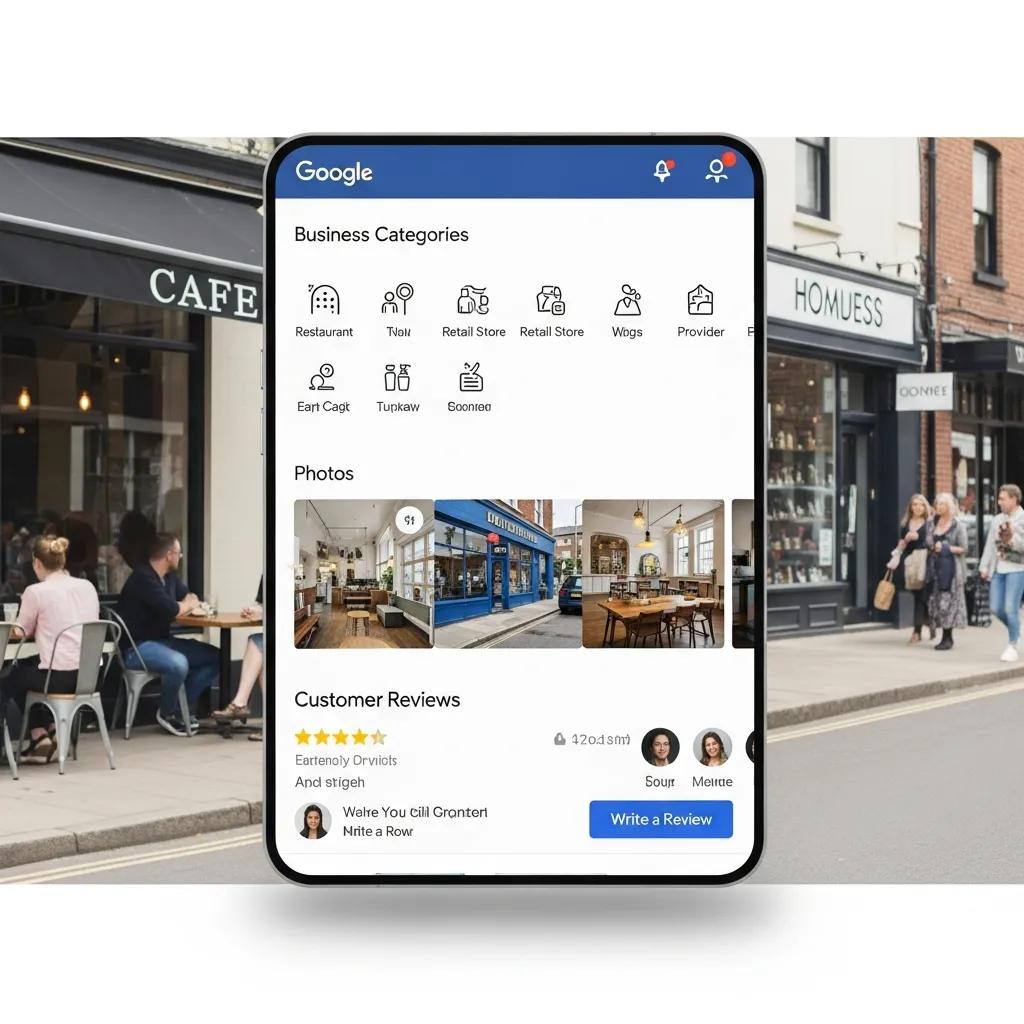
GBP offers fields and tools like business name, categories, photos and videos, Posts (offers/updates/events), attributes (for example, “wheelchair accessible”), service and product listings, Q&A, messaging, and reviews. Each feature helps with discovery or conversion: photos and videos increase clicks; categories and attributes determine eligibility for queries; Posts create timely CTAs; and Q&A and messaging handle pre-sale questions.
Optimize features with simple actions: upload high-resolution images at recommended sizes, post weekly with a focused CTA, and keep service listings accurate.
A practical rollout looks like this:
- Finish core profile fields first,
- Add media and a steady cadence of Posts next,
- Then enable messaging and product lists as you scale.
Used correctly, these features increase the chance of rich results and lift local performance. Next is a hands-on setup and maintenance checklist you can follow.
How to manage and optimize your Google Business Profile effectively

Managing GBP is ongoing: accurate setup, verified control, regular updates, and metrics monitoring. Consistent, small efforts compound into stronger local SEO. Start with a verified profile and a canonical NAP, then schedule recurring tasks like adding photos, publishing Posts, answering Q&A, and responding to reviews. Use Insights—search queries, photo views, calls, and direction requests—to decide which actions to scale and which services to promote.
Below is a practical checklist for GBP setup and ongoing maintenance to organize tasks and responsibilities.
| Task | Recommended Frequency | Who / How / Why |
|---|---|---|
| Complete profile fields (name, category, hours, services) | Once at setup, review quarterly | Owner or marketing lead; ensures accurate, discovery-ready information |
| Verify profile | Once at setup | Required to control the listing; use postcard/phone/email/bulk when eligible |
| Add photos & videos | Weekly or biweekly | Marketing staff; boosts engagement and perceived prominence |
| Publish Google Posts | Weekly | Content or local manager; promotes offers and keeps the profile active |
| Monitor & respond to reviews | Daily to weekly | Customer support/owner; builds trust and influences ranking |
This checklist clarifies who does what and how often so teams can keep discovery signals steady. Below is a quick, numbered setup checklist for fast execution.
- Claim or create the listing and enter the exact business name and primary category.
- Complete all profile fields, including services, attributes, and a short natural description that includes target keywords.
- Choose a verification method (postcard, phone, email, or bulk) and verify promptly.
- Upload high-quality photos (logo, cover, interior, exterior, staff) and add service/product entries.
- Enable messaging, add appointment links, set regular and special hours, and check Insights weekly.
These steps form the operational backbone for GBP optimization and naturally lead into citation and NAP consistency best practices.
Many businesses bring in specialists after setup. DockSyde Creative offers citation management, review workflows, and ongoing local SEO execution to automate verification follow-ups, fix inconsistent citations, and keep GBP activity consistent. Our work ties optimization to measurable leads—contact DockSyde Creative if you prefer a managed approach.
Best practices for GBP setup and verification
Start with authoritative, consistent data: use the exact business name you use on signage and legal records, pick the most accurate primary category, and only list service areas when appropriate. Verification proves control; postcards are common, but phone, email, or bulk verification might be available for qualifying businesses.
Common pitfalls to avoid:
- Adding keywords to the business name,
- Creating duplicate listings for the same address,
- Using inconsistent address or phone formats across directories.
Prevent mistakes by auditing existing citations before claiming the profile and documenting a canonical NAP format. After verification, lock core fields and publish weekly content to show activity—next we cover a practical citation audit and correction workflow.
Maintaining NAP consistency across platforms
NAP consistency matters because search engines cross-check profile data with external citations to judge credibility. Discrepancies confuse systems and customers, which can hurt visibility. Start with a citation audit: list current directory entries, flag name/address/phone mismatches, and prioritize fixes by impact and effort. Focus first on major directories, industry aggregators, and data providers that feed many platforms.
Corrective workflow: claim or update the highest-impact listings first, record changes, and schedule quarterly audits to prevent regressions. For multi-location businesses, create a governance model with templates and access controls to keep NAP consistent at scale. Clean, consistent citations strengthen GBP prominence and reduce ranking friction.
Which Google Maps ranking factors affect your profile performance?

Maps ranking hinges on relevance, distance, and prominence. Understanding each helps you prioritize work. Relevance comes from categories and content alignment with queries; distance is mostly fixed but can be managed with service-area settings; prominence grows with reviews, citations, and local content. Use quick wins first—categories, photos, reviews—then invest in citation cleanup and content strategies that build long-term prominence.
The table below compares major ranking factors, why they matter, and how to improve them.
| Ranking Factor | Why it matters | Impact & actionable steps |
|---|---|---|
| Relevance (categories, services) | Helps match your profile to relevant searches | Review primary and secondary categories; add service-focused descriptions with natural keywords |
| Proximity (distance) | Nearer results often get priority for local queries | Use service-area settings for delivery or ensure accurate address for walk-ins |
| Prominence (reviews, citations) | Signals trust and real-world recognition | Ask for reviews, fix citations, build local backlinks and local content |
| Engagement (clicks, calls, directions) | Behavioral signals that show usefulness | Track Insights, run CTAs in Posts, and optimize photos and offers |
This prioritization helps small teams focus on high-impact tasks first and forms the basis for a phased plan when scaling multiple locations. Next, we break down how reviews and categories affect ranking and conversions.
How reviews and ratings affect your GBP ranking
Reviews and ratings influence rankings and conversions. Google treats review volume and recency as prominence signals, while customers use sentiment to make decisions. Ask for reviews ethically at natural touchpoints, make it easy to leave feedback, and send gentle reminders when appropriate. Respond to reviews quickly—positive and negative—to show you care.
Suggested cadence: request reviews after positive interactions, monitor reviews daily, and respond within 48–72 hours.
Response templates should thank the reviewer and reference specifics for positive feedback, and offer to resolve issues offline for negative feedback. Solid review management lifts click-through rates and local ranking potential. Category selection works alongside reviews to improve relevance.
The role of categories and business attributes in local search
Primary and secondary categories determine which queries your GBP can appear for; attributes add filters and highlight amenities. Choosing the right primary category secures core visibility, while selective secondary categories expand reach without diluting signals. Attributes like “women-led” or “onsite parking” create extra snippets and can influence users with specific intent.
Audit categories quarterly and align them with your most profitable services. Avoid irrelevant categories that muddy relevance. Correct category and attribute settings increase your match rate for queries and improve the chance of appearing in relevant local packs.
How to use GBP features to engage customers
GBP features—Posts, Q&A, product and service listings, and messaging—create direct touchpoints that drive engagement and conversions when used deliberately. Posts promote limited-time offers or events with a clear CTA, Q&A surfaces common questions, product and service listings show offerings directly in search, and messaging opens quick pre-sale conversations. Use a content calendar to schedule Posts, photo uploads, and review responses so the profile stays fresh.
Practical tactics:
- Publish Posts weekly to highlight offers, events, or seasonal services with a single clear CTA.
- Fill product and service sections with concise descriptions and pricing where possible.
- Monitor Q&A proactively and mark authoritative answers to guide searchers.
Measure each tactic: track Post clicks, search queries, and action metrics to refine messaging. If your team is stretched, a partner can maintain the cadence and quality required to see results.
DockSyde Creative can build your content calendar, manage Posts, and run review-response workflows as part of a local SEO program. We keep GBP profiles active and focused on lead generation so your team can run the business.
What are Google Posts and how to use them well
Google Posts are short updates—offers, events, or news—that appear in your GBP and can drive calls, bookings, or page visits. Keep Posts concise, use a single CTA, and include an image optimized for mobile. Best practice: publish at least one Post per week, mixing promotional and helpful content. Use high-contrast visuals and keep main text under about 150 characters for better mobile readability.
Use Posts for limited-time discounts, new services, or customer stories with a CTA that drives action. Track engagement in GBP Insights and iterate on the CTAs and images that perform best to refine your content calendar.
Using review management to build trust and reputation
A lightweight review management playbook has four steps:
- Ask for reviews at key moments.
- Monitor reviews daily.
- Respond with appreciation and practical resolution.
- Use feedback to improve operations.
Timing matters—request reviews right after successful transactions or completed services when customers are most likely to leave positive feedback. Template responses should reference specifics, thank the reviewer, and invite offline follow-up for negative issues.
Turn negative reviews into improvements by documenting recurring issues, assigning fixes, and publicly noting changes to show responsiveness. That cycle improves sentiment and can boost prominence as review volume and quality increase.
Advanced strategies for improving local SEO with GBP

Advanced GBP tactics include citation cleanup and amplification, structured data/schema on your website, technical local SEO audits, and governance for multi-location scalability. These approaches strengthen on-profile signals and raise prominence. Citation work audits scattered listings, corrects inconsistencies, and prioritizes sources that feed major aggregators. Adding LocalBusiness JSON-LD on your site helps search engines connect on-site signals with GBP and improves eligibility for rich results.
Use the table below to compare complexity and expected impact so you can prioritize work wisely.
| Tactic | Complexity | Expected Impact / Timeframe |
|---|---|---|
| Citation cleanup & consolidation | Medium | Improves prominence within 1–3 months after corrections |
| LocalBusiness JSON-LD schema | Medium | Helps eligibility for rich results; effects appear in weeks to months |
| Multi-location governance & templates | High | Enables scalable consistency; ROI depends on number of locations |
| Technical local SEO audit | High | Uncovers site issues affecting GBP signals; improvements compound over months |
These tactics require ongoing monitoring and, at times, technical implementation. That’s why many teams bring in specialists for execution and governance.
How citation management boosts local search rankings
Citation management improves local rankings by increasing the number and accuracy of external references that corroborate your GBP. Start with an audit to catalog citations, flag inconsistencies, and rank sources by impact—local directories, industry sites, and data aggregators matter most. Fix high-impact citations and remove duplicates to reduce data-feed confusion; you’ll often see ranking improvements within weeks to months.
Recommended cadence: a quarterly citation audit with monthly monitoring of major directories. Tools speed discovery, but manual checks on priority sources ensure quality. Consistent citation work strengthens prominence and supports the rest of your GBP strategy.
The role of structured data and schema markup
Structured data such as LocalBusiness and Organization JSON-LD gives search engines a clear, machine-readable map of your core business details—name, address, phone, hours, services—and complements your GBP by reinforcing the same signals on your website. Implementing schema improves entity clarity and can increase the chance of rich snippets. Common fields include name, address, telephone, geo coordinates, opening hours, aggregateRating, and offered services.
Publish schema in the site header or via CMS plugins and test it with structured-data validation tools. When paired with a verified GBP and consistent citations, schema strengthens search engines’ understanding of your business and helps local performance over time. If you prefer managed help, DockSyde Creative implements structured data and runs technical local SEO audits to align on-site schema with GBP signals—contact us to explore solutions that fit your scale and goals.
Frequently Asked Questions
1. How often should I update my Google Business Profile?
Update your GBP regularly. Aim to refresh the profile at least once a week—add new photos, publish a Post, and respond to reviews. Regular activity signals to Google that your business is active and gives customers accurate, up-to-date information about hours, services, and promotions.
2. What types of posts can I create on Google Business Profile?
GBP supports several post types: offers, events, updates, and product highlights. Use offers for discounts, events for upcoming activities, updates for news, and product posts to showcase items or services. Each Post should include a single, clear CTA like “Call now” or “Learn more.”
3. How can I effectively manage customer reviews on my Google Business Profile?
Manage reviews by asking for feedback at natural moments, monitoring reviews frequently, and responding promptly. Thank customers for positive feedback and offer to resolve problems offline for negative reviews. Regularly review feedback to spot trends and improve operations.
4. What are the consequences of having inconsistent NAP information?
Inconsistent Name, Address, and Phone (NAP) across directories confuses search engines and customers, which can lower local visibility and erode trust. Fix this by auditing citations, standardizing your canonical NAP format, and correcting high-impact listings first.
5. How does Google determine the ranking of my business in local search results?
Google ranks local results using three main factors: relevance (how well your profile matches the query), distance (how close you are to the searcher), and prominence (how well-known your business appears through reviews, citations, and links). Optimizing your GBP with accurate information and active content improves your chances of ranking well.
6. Can I use Google Business Profile for multiple locations?
Yes. Each location should have its own profile with precise, consistent information. Maintain uniformity across listings and update them regularly. For multiple locations, set up a governance model to manage templates, access, and quality control.
7. What role does structured data play in local SEO for my business?
Structured data (LocalBusiness schema) helps search engines understand your business details in a standardized format. Implementing schema reinforces the information in your GBP and can increase the likelihood of rich snippets—improving visibility and click-through in search results.